Let's clear this up right at the start. No, Frankfurt am Main is not the capital of Germany. That title belongs to Berlin, and has since reunification in 1990. But if you've ever heard Frankfurt called a "capital," you're not wrong either. It's Germany's undisputed financial capital and a leading economic powerhouse. This confusion is more than a trivia question—it's a key to understanding modern Germany. Frankfurt's story is about what happens when a city becomes so vital in one specific area that its unofficial title overshadows its official political status. I've lived near Frankfurt for years, and I still meet tourists at the Römerberg who are genuinely surprised to learn they're not in the nation's political heart. This article isn't just about correcting a common misconception; it's about exploring why Frankfurt holds this unique, powerful position and what it means for you as a visitor or someone trying to understand Germany.
What You'll Discover in This Guide
The Capital Confusion Explained
So why the mix-up? It stems from a few overlapping facts. First, Frankfurt is a global city in a way that even Berlin sometimes isn't. It's home to the European Central Bank (ECB), the Deutsche Bundesbank (Germany's central bank), and the Frankfurt Stock Exchange—the largest in Germany. If you follow financial news, you hear "Frankfurt" constantly. Second, its airport, Flughafen Frankfurt am Main, is Germany's busiest and a major European hub. For many international travelers, their first and sometimes only stop in Germany is Frankfurt, creating a subconscious link to centrality. Third, there's a historical nugget: Frankfurt was indeed the seat of the first democratically elected German parliament in 1848-49 and was proposed as the capital of a unified Germany. Berlin won that contest, but the historical echo remains.
Frankfurt as Germany's Financial Heart
Calling Frankfurt just a "banking city" is like calling a Formula 1 car "just a vehicle." It's accurate but misses the scale and intensity. The Bankenviertel (Banking District) is a forest of skyscrapers, a sight utterly unique in Germany. The skyline, nicknamed "Mainhattan," is a physical testament to its economic muscle.
Key Institutions That Define the Financial Capital
The European Central Bank (ECB) is the big one. Setting monetary policy for the Eurozone from its distinctive twin-tower headquarters gives Frankfurt a claim to being one of the EU's most important cities. The Deutsche Börse (Frankfurt Stock Exchange) is where Germany's corporate giants are listed. Then there's the cluster of major commercial banks—Deutsche Bank, Commerzbank, DZ Bank—and countless international financial firms. This concentration creates an ecosystem. Lawyers, consultants, and tech firms serving finance all flock here. The energy is palpable; walk around the Opernplatz area during a weekday lunch hour and you'll feel it.
This status isn't abstract. It shapes the city. Rents in the Westend and Nordend districts are among Germany's highest. The restaurant scene caters to expense-account lunches and high-end dinners. The airport's connections are phenomenal because the global finance crowd demands them. It's a city built for, and by, economic activity.
Frankfurt's Historical Role as a Capital
Here's where it gets interesting for history buffs. While never the capital of a modern German nation-state, Frankfurt has worn crowns of different sorts.
For centuries, it was a Free Imperial City within the Holy Roman Empire, answering only to the Emperor. After Napoleon, it became a sovereign city-state. Its pivotal moment came with the 1848 Revolution. Liberals and democrats from across the German states met in Frankfurt's Paulskirche (St. Paul's Church) to draft a constitution for a unified, democratic Germany. They envisioned Frankfurt as its capital. The revolution failed, crushed by Prussian monarchy, and the dream died. When Germany unified under Prussian leadership in 1871, Berlin was the obvious choice.
That historical "what if" lingers. The Paulskirche is a national monument to democracy. Many feel Frankfurt represents a different, more liberal and cosmopolitan German tradition compared to the Prussian-military legacy of Berlin. This isn't just old news. It informs the city's modern, open, and international character.
Visiting Modern Frankfurt: A Dual City Experience
Visiting Frankfurt means experiencing this duality: the soaring, glass-and-steel world of finance versus the cobblestoned, timber-framed charm of its reconstructed Altstadt (Old Town). Most travelers make the mistake of spending all their time in one or the other. The magic is in the contrast.
Top Attractions That Showcase Both Sides
You need a plan to see both faces. Here’s a practical breakdown of must-sees.
| Attraction | What It Is | Address / Location | Key Visitor Info |
|---|---|---|---|
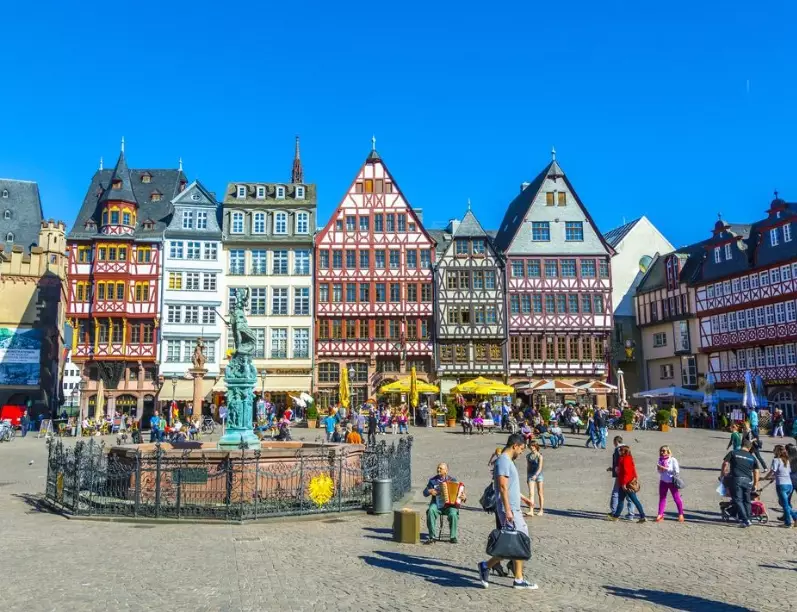
| Römerberg | The picturesque Old Town square with the Römer (city hall) and half-timbered houses. | Römerberg 23, 60311 Frankfurt | Free, always open. Best in morning light. The Christmas market here is legendary. |
| Main Tower Observation Deck | The only skyscraper with a public viewing platform, offering the definitive "Mainhattan" view. | Neue Mainzer Straße 52-58 | Adults ~€9. Open daily, hours extend in summer. Go just before sunset to see the city light up. |
| Städel Museum | One of Germany's most important art museums, spanning 700 years. | Schaumainkai 63, 60596 Frankfurt | Adults ~€18. Closed Mondays. Allow 3+ hours. Its modern extension is an architectural marvel. |
| Eiserner Steg (Iron Footbridge) | The iconic pedestrian bridge over the Main, covered in love locks. | Connecting Römerberg to Sachsenhausen | Free. Perfect for photos of the skyline. The riverside paths (Museumsufer) are great for walks. |
| Goethe House | Birthplace of Germany's literary giant, Johann Wolfgang von Goethe. | Großer Hirschgraben 23-25 | Adults ~€10. Gives insight into 18th-century bourgeois life. |
A Local's Tip for Beating the Crowds
Everyone goes to the Römerberg. It's beautiful, but packed. For a more authentic slice of old Frankfurt with fewer tourists, walk five minutes south to the Fahrgasse and Kleine Rittergasse area. The buildings are just as charming, there are quirky little shops, and you can actually hear yourself think. Grab an Apfelwein (Frankfurt's tart cider) at a traditional tavern in Alt-Sachsenhausen, just across the Eiserner Steg, to escape the banking crowds.
The food scene mirrors the split. You have Michelin-starred temples of gastronomy in the banking district (like Franziska), and then you have the cozy Apfelwein pubs in Sachsenhausen serving Handkäs mit Musik (a pungent marinated cheese) and Grüne Soße (herb sauce with eggs and potatoes). Try both. The Grüne Soße from the weekly market on Konstablerwache is a local ritual.
Getting Around: It's Easier Than You Think
Frankfurt is compact. The city center (Innenstadt) is very walkable. For longer trips, the public transport system (RMV) is efficient. A day ticket (Tageskarte) for the inner city zone (Zone 50) costs around €6 and covers all trams, U-Bahn (subway), and S-Bahn (suburban train) rides. Don't rent a car for the city center—traffic and parking are a headache. The S-Bahn lines S8 and S9 connect the airport to the main train station (Hauptbahnhof) in about 15 minutes.
Your Questions on Frankfurt Answered
I'm flying into Frankfurt Airport for a layover. Can I quickly see the city?
Absolutely, it's one of the best airports for a city dash. Take the S-Bahn (S8 or S9) directly to "Frankfurt (Main) Hauptwache" station (about 20 mins). You'll be steps from the Zeil shopping street and a 10-minute walk from the Römerberg. If you have 4-5 hours, you can comfortably see the main square, walk across the Eiserner Steg, and grab a meal. Store your luggage at the airport's left-luggage facilities. Just keep a close eye on the time for your return trip.
Is Frankfurt expensive to visit compared to Berlin or Munich?
It sits somewhere in the middle. Hotel prices in the city center, especially on weekdays, can be steep due to business travel. However, weekends often see significant drops. Dining offers a wide range. You can pay a fortune for a steak in the Bankenviertel or have a hearty, affordable meal in an Apfelwein pub. Public transport and museum entry fees are on par with other major German cities. A pro tip: Look for accommodation in neighborhoods just outside the center like Bornheim or Bockenheim, which are well-connected and have more local character.
What's the biggest mistake tourists make when visiting Frankfurt?
Only staying around the Hauptbahnhof (main train station). The area directly in front of the station is, frankly, gritty and not representative of the city. I see travelers check into a hotel there, get a poor first impression, and miss the beautiful parts just a short tram ride away. Another mistake is treating Frankfurt as just a transit hub and not giving it a full day. The blend of ultra-modern and traditional is unique in Germany and worth exploring properly.
If Frankfurt is the financial capital, what are Berlin and Munich known for?
This gets to the heart of Germany's decentralized power. Berlin is the political, cultural, and creative capital. It's about government, history, art, and nightlife. Munich is the industrial and high-tech capital, home to giants like BMW, Siemens, and many tech startups, coupled with a strong traditional Bavarian culture. Hamburg is the media and trade capital with its massive port. Frankfurt's lane is clearly finance, business, and transportation. No single city dominates everything, which is a key feature of the country.
Is it worth going up a skyscraper, and which one?
Yes, it's essential to understand the city's scale. The Main Tower is the best choice for a first-time visitor. Its viewing platform is open-air (partially), and its central location gives you the classic skyline view that includes the ECB towers and the rest of the banking district. The restaurant/bar at the top of the Movenpick Hotel (next to the Main Tower) is a free alternative if you just want a drink with a view, but the perspective isn't as high or panoramic. Book your Main Tower ticket online to skip the queue.